
Our investment in Aigentsphere: When governance becomes the growth enabler

The workforce is changing faster than the systems built to manage it
For decades, enterprises have invested in sophisticated infrastructure to manage their most important assets: their people. Performance systems, compliance frameworks, risk controls, workforce analytics. The tools aren’t glamorous, but they’re what make large organisations function at scale.
Now something new is entering the workforce — and most organisations have no equivalent infrastructure to manage it.
AI agents are being deployed across customer service, operations, finance and internal productivity. Many enterprises have dozens, sometimes hundreds, running simultaneously across different vendors, teams and use cases. Most have no single view of what those agents are actually doing, what they cost, or how they’re performing. No system of record. No audit trail. No real-time visibility.
This is not a distant problem. It is happening now, inside organisations that have spent years building strong governance cultures — and it represents one of the most significant gaps in enterprise AI adoption today.
The founders who’ve lived this problem
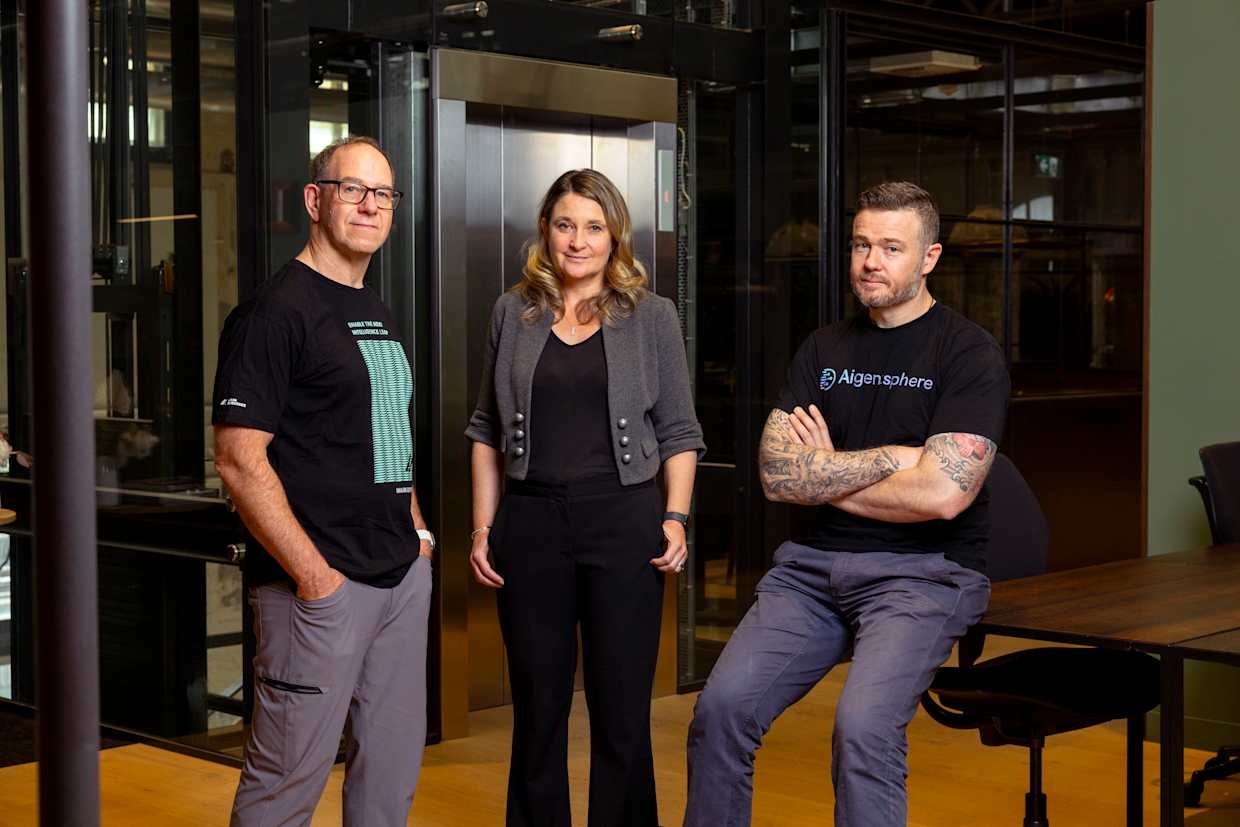
When I first met Quinton Anderson and Kelly Bayer Rosmarin — which, admittedly, happened in a coffee shop rather than a boardroom — what struck me wasn’t just the strength of the idea. It was who was behind it.
Quinton served as CIO at both CBA and Optus, navigating the technical complexity of some of Australia’s largest enterprises. Kelly ran the institutional bank at CBA and later led Optus as its CEO. Between them, they’ve sat in exactly the rooms where AI governance conversations are now happening — and where the answers have too often fallen short.
This is a founding team that has spent years on the receiving end of regulators, incident response rooms, and board-level scrutiny. They didn’t come to AI governance as an intellectual exercise. They came to it because they understood, firsthand, how badly it was needed.
What Aigentsphere is building — and why it matters now
The analogy Quinton uses is a useful one: enterprises already know how to manage intelligence at scale. They do it every day through HR systems, performance management frameworks, risk controls and audit processes. The problem is that none of those systems were built for AI agents.
Aigentsphere is building the category equivalent for the AI workforce: a unified control layer that lets organisations register and onboard agents, monitor performance in real time, track costs, enforce policies, and generate compliance reporting — all from a single, independent view.
The timing is not coincidental. Board-level pressure to adopt AI faster is colliding with growing regulatory scrutiny about whether those systems are safe, unbiased and auditable. That tension is creating urgency. Organisations can no longer afford to move fast with AI and worry about governance later. They need both, simultaneously.
What Aigentsphere provides is the infrastructure that makes that possible.
Customer signal that’s hard to ignore
The team had their first customer pilot running in November last year — seven months after the original concept, four months after a working prototype. That is a fast path from idea to deployment, and the result is already producing strong signal.
That first pilot customer has since signed a three-year contract.
In one early deployment, the platform identified a live compliance issue that had bypassed testing and QA entirely — enabling the enterprise to act immediately, remediate the affected customer, and retrain the agent before the problem could escalate. That’s not a theoretical value proposition. That’s the product doing exactly what it needs to do, in a real environment, under real conditions.
The implications are significant. In a world where AI agents are executing complex workflows autonomously, a single undetected compliance failure can move from edge case to enterprise-wide problem faster than a human team can respond. Aigentsphere gives organisations the visibility to catch it before that happens.
Where this fits in our strategy
At Main Sequence, we invest in technology that tackles some of the most significant structural challenges facing the economy and society. Aigentsphere sits squarely within our Next Intelligence Leap thesis — the idea that the most important work right now isn’t just making AI more capable, but making it more deployable at scale.
We’ve watched agentic AI evolve from a technical curiosity into a genuine enterprise transformation. But transformation at scale requires infrastructure. It requires systems of record, accountability layers, and governance frameworks that can keep pace with the rate of deployment. Without them, the transition from AI experimentation to enterprise-wide adoption stalls — not because of technical failure, but because organisations can’t prove to their boards, their regulators or their customers that they’re in control.
Aigentsphere is building that missing layer. And they’re building it with the credibility, the customer validation, and the urgency that the moment demands.
What’s next
The $4 million seed round will support the team in expanding engineering capacity, accelerating platform development, and extending operations across Australia and the United States.
The ambition is clear: to become the system of record that every enterprise deploying AI agents depends on. As that workforce grows — and it will grow significantly — organisations will need exactly what Aigentsphere is building. The question is whether they build that infrastructure now, intentionally, or deal with the consequences of not having it later.
Quinton and Kelly have spent their careers solving exactly this kind of problem inside large organisations. Now they’re building the product they always wished existed.
We’re backing them to do it.
Written by

Mike Zimmerman
Partner
WHat to read next
.jpg)

Ben Hansky
October 7, 2025


Elaine Stead
July 15, 2025


Danielle Haj-Moussa
June 13, 2025
WHat to read next


Alejandra Romero
April 14, 2026

Alezeia Brown
March 26, 2026


Jason Whitfield
February 20, 2026
Stay in Touch
